Showing posts with label jon stewart. Show all posts

Tuesday, June 11, 2013

Do People Actually Learn from Colbert and Stewart?

We've had some time now to review an emerging body of work that asks whether people learn from such faux news programs as The Daily Show with Jon Stewart and The Colbert Report.  While I'm not going to bore you with a formal lit review, I will try to summarize what we know so far about the effects of such "soft news" programs.
  • People view such programs differently than traditional news.  Call this the couch potato hypothesis.  With less mental effort you get less learning.  After all, most people sit down in front of the TV to be entertained and even when they do try to be informed by such content, the brain is wired differently. 
  • Similar to above is the empty-calorie hypothesis, that idea that people will rely on humorous forms of news and feel filled up, like sucking on a Coke, and won't consume their vegetables (real news).  The result?  Less knowledge.
  • What you know matters.  Well-informed folks glean more from an information source than less-informed.  That said, TV best serves those who know least, especially TV news, because of the way TV tells a story versus the traditional inverted pyramid of print news, which with its emphasis on the latest information first assumes prior knowledge.
  • Humor is thought to get in the way of learning, but to help in persuasion.  The theory is straightforward -- humor lowers our defenses, reduces counter-arguing, and is therefore more likely to persuade.  But humor interferes with actual learning.
  • The content of these faux news programs resembles in some ways the TV newscasts.  Content analyses find many similarities, though these also find dramatic differences.  It's hard to make tragedy funny, and often Colbert and Stewart take the easy way out, the easy laugh, because it can backfire if you try to make a tragedy into something it's not.  Quite simply, unless you're consuming traditional news, there are huge holes in your information, gaps found in news quizzes or measures of political knowledge.
  • But ... the people who watch these programs tend to be news junkies anyway, well-educated and young, people who "get" the jokes because they're at least moderately informed.
  • Finally, it's that "moderate" thing that matters.  It's the folks who attend to no news but watch these programs who come out losers, at least as measured by tests of political knowledge.
  • Beware the methodological mess-up.  Sometimes scholars will combine these two shows with the late-night talk shows (i.e., Jay Leno).  They are not the same.  Different content, different audiences, different results.  I'm in the middle of a study that finds, today, you really have to ask about exposure to specific networks (Fox News, etc.) and even specific programs (The O'Reilly Factor) to get at the kinds of effects that matter in political communication.


Monday, April 15, 2013

It Depends ...

For decades we've wrestled with explaining why some people seem to learn from TV news and some don't.  A subset of that work is trying to understand who learns from faux news programs like The Daily Show, an area of my own research.  There's a new paper out that goes a long way, I think, in explaining why some people learn from late-night comedies and some do not.  You know it's good.  It cites me.  Twice.

Anyway, the basic finding is summed up nicely in the study text:
The results suggest that viewers who orient to The Daily Show as news, or as a mix of news and entertainment, activate greater mental resources than those who orient to The Daily Show as purely entertainment.
So, to put it another way, it depends on how you approach the program.  This is not unlike a small body of work I've cited myself that argues one reason many people don't learn all that much from TV news is that they approach the medium as "easy" and relaxing, while they approach print as "hard" and requiring more mental effort.  The result is obvious.  Greater mental effort, greater learning.  As an aside, the less educated or interested do tend to learn something from TV news, in part because of the way stories there are structured as opposed to traditional print articles.

Here, this study published in Mass Communication & Society suggests much the same effect for late-night comedies.  It all depends on why you watch.


Tuesday, June 21, 2011

Fox Viewers Misinformed?

Jon Stewart visited Chris Wallace of Fox News and said the following:
Who are the most consistently misinformed media viewers?  The most consistently misinformed? Fox, Fox viewers, consistently, every poll.
Love your work, Jon.  And I sympathize with your frustrations.  But it ain't so. Politifact even fact checked Stewart and found out -- it ain't so.

But Politifact gets it kinda wrong too.

There is misinformed.  There is uninformed.  I think Stewart really meant what he said -- misinformed -- while Politifact appears to focus on a different concept -- uninformed.

Allow me split some conceptual hairs here.

Uninformed is fairly straightforward.  People do poorly on tests of political knowledge.  Politifact notes that while Fox viewers in general don't do particularly well on such tests, viewers of specific Fox programs, such as The O'Reilly Factor, do just as well as Stewart's own audience for The Daily Show.

Misinformed, though, is different.  For example, Fox viewers back in ancient times believed there were weapons of mass destruction in Iraq even when it became obvious to the rest of the planet that no, there weren't any, not for quite a while.  I think this is what Stewart meant, that Fox viewers are misinformed because of the slant, the angle, the conservative bent and narrative of the network even in its "straight" news.  That's being misinformed, not uninformed.  Even Politifact admits this by saying: "This study is probably the strongest support we found for Stewart’s claim, in part because the difference between Fox and the other news outlets was so stark, and in part because the questions asked have pretty clear-cut "right" and "wrong" answers."

As much as I respect Politifact, score this one for Stewart.  The truth-o-meter should not read False. 

Wednesday, December 1, 2010

Beck, Stewart, Colbert, et al

A different take by Jon Bershad, from a week or so ago, on the continuing saga of TV talkmeisters Glenn Beck, Jon Stewart, and Stephen Colbert.  Beck kinda has a point, only kinda and only barely, about jokes being a "drug" in a news context.  Anyway, think of this as a quick fyi as I run out to give an exam.

Saturday, October 30, 2010

When Parody Becomes News
And Vice Versa

We used to worry about the separation of church and state (news and advertising).  We used to worry about the blurring of opinion and news.

Doesn't that seem so quaint?

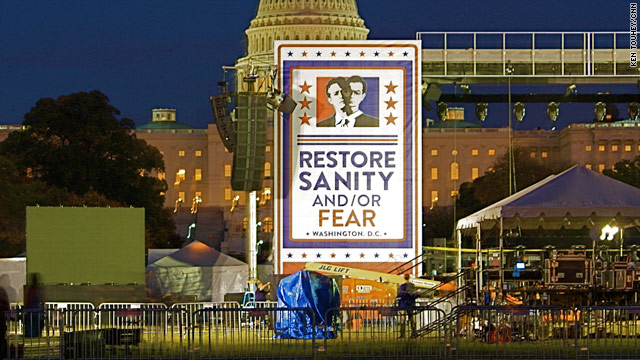
Now we have the blurring of comedy, parody, and news, and lots of people hanging around Washington DC when they should be watching the Georgia-Florida game.  The Stewart/Colbert thing will no doubt be funny, will get covered by cable news, and will get far more attention that it probably deserves.  But what the hell.  These guys are damn funny, almost as funny as some of the candidates running for office (such as my congressional district).

Wednesday, June 16, 2010

Jon Stewart and Diminishing Returns

Watching Jon Stewart has diminishing returns.  Yeah, you can insert a joke here if you like.  Seems too easy, so I'm gonna move on.

There's a new study out, though, that finds watching Jon Stewart's The Daily Show leads to greater attentiveness to the news, but the more you watch, the less of an effect it has.  The International Journal of Public Opinion Research article also notes that one-out-of-five viewers have little interest in politics -- fascinating given the content of the program.

A major point gets to the crux of the argument between those who believe enertainment news programs either fail to inform, or actually do inform, some people.  This article falls on the "inform" side, suggesting that many with no interest are exposed to some news and information, thus leading to greater attentiveness and, I suppose by default, greater knowledge.

Tuesday, December 15, 2009

Late-Night Comedies and Political Knowledge

Late-night comedy programs do lead to greater knowledge, according to a fascinating study published in Communication Research, but the analysis finds this knowledge comes from easy questions with few response alternatives and mostly among inattentive viewers.

Wow.

This may be one of the better stabs at understanding how late-night comedy programs affect learning that I've seen, and its discussion of political knowledge research is excellent.  Now that I'm done gushing, let's get to the details.  Using item response theory and some slick computational tricks to analyze 2004 election data, they looked at exposure to a general measure that includes most all late-night shows (Letterman, Stewart, et al., see below).  Table 1 breaks down the item-by-item results, which for the statistically challenged will be something of, um, a challenge. 

If you work carefully through the results, and read the conclusions, you get to a few main points:
  • Fewer response alternatives (meaning fewer choices among possible answers) often equals an easier question, or at least less item difficulty.
  • Watching late-night comedies does lead to slightly more knowledge.
  • But -- on the point above -- this is mostly on easy questions.  This is perhaps more of a TV effect than anything else, some incidental learning. 
  • And "this increase is especially pronounced among the viewers who do not pay close attention to public affairs."  That's important too, because it fits some of what we are beginning to understand about television news, which seems to inform only the less informed.
A must-read for anyone interested in the effects of late-night programming.


Weaknesses?  Every study has them.  The biggest for me?  It's easy to quibble with their catch-all independent variable.  Letterman ain't Leno ain't Stewart ain't Colbert, so a single item probably fails to capture significant differences.  This is a secondary analysis, so the authors worked with what they had available, but it's certainly a question that deserves further study.

Thursday, October 8, 2009

Of Cottage Academic Industries

Some television programs create a cottage industry of academic research.  Sesame Street is one clear example.  Buffy the Vampire Slayer -- believe it or not -- is another. 

And if you study political communication, a couple of guys are cottage industries of a sort for academics.  I speak in praise, obviously, of Jon Stewart and Stephen Colbert.

Here's the abstract and full pdf of yet another study, this time on The Colbert Report.  As a PhDweeb who did some of the earliest research on "new news" and faux news programs, I'm allowed to take the high road, to sniff at these latecomers, and pretend superiority.  But in truth the stuff coming out now is quite good, better than the early studies, including mine.  This one looks at the ideology of experimental subjects and how they respond to Colbert's partisan humor.  It gets into how people negotiate "ambiguous political messages from ambiguous sources," which is a neat angle to take given Colbert's approach.  You can read it yourself.

Think of this as another brick in the wall of showing how Colbert and Stewart have very different effects, given their approaches.  The conclusion is a bit obvious, that we need to consider predispositions in understanding how people view such programs, but the work here is excellent, especially the discussion of what it all may mean.

Tuesday, September 29, 2009

Stewart vs. Colbert

There is an emerging bit of scholarly work that suggests those two popular comedy faux news programs -- Jon Stewart's The Daily Show and Stephen Colbert's The Colbert Report -- have very different effects on their audiences.

Stewart's show is more straightforward.  He slams Republicans, occasionally Democrats, but basically you know where's coming from. Colbert is more sneaky.  He plays a Republican blowhard to make fun of Republicans and blowhards.  But his approach confuses some.  In other words, he nudges people to like Republicans and those he satirizes, according to one study.

Why mention this?  In part the issue is methodological.  You wouldn't want to measure exposure to the two programs and then collapse this into a single index called Exposure to Late Night Comedy.  There are enough differences, at least suggested in some published studies or a few under consideration at journals, that combining the two might, if not cancel one another out, create measurement error issues.  And I think I broke a personal record for the number of commas in a single sentence.  Apologies.

Lots of people mention such programs as a source of their news and information, as places that influence what people know.  If true, we must be careful in how we take these questions and combine them into a single variable.  In fact, best I can tell from some early data, this would be a mistake.


What dependent variables would this most likely influence?  Probably not knowledge so much as attitudinal items, such as like/dislike of candidates or even attitudes about major institutions such as Congress or the Press.  I don't see it influencing trust in government but it might influence internal or external efficacy.  In general, we need to carefully examine differences between these two programs on key criterion variables before simply combining them in a single index.

Thursday, August 20, 2009

SLOPpy Polls

A SLOP is a "self-selected opinion poll," most often seen on TV where some talkinghead host asks you to vote via phone or online on some issue. As AAPOR points out, "there is no control over respondent selection because anyone can call in an opinion." So don't be surprised when watchers of Lou Dobbs, for example, all call in and skew the program's "poll" results to favor -- surprisingly -- what Dobbs "thinks."

So as a measure of what people think, it's a load of complete crap.

And that brings us to this bit seen below by funnyman Jon Stewart. Thanks to Nick Browning for pointing this one out to me. As often is the case, Stewart sums it all up and makes it funny to boot.


The Daily Show With Jon StewartMon - Thurs 11p / 10c
Poll Bearers
www.thedailyshow.com
Daily Show
Full Episodes
Political HumorHealthcare Protests

Thursday, March 19, 2009

Is Jon Stewart Hurting America?

Remember when Jon Stewart went on the old Crossfire show? He had a simple request of the program's two doofy hosts:

"Stop hurting America."

Stewart's appearance helped kill the CNN show. Not a great loss for political discourse, although its death and that of related programs left a void soon filled by a series of ideologically-focused, single-person programs. You know the gang: O'Reilly, Dobbs, Grace, Olbermann, Hannity, etc. So in the long run I'm not so sure killing Crossfire was a good thing, given what happened next, but there was no way to know that at the time.

And then, of course, Cramer came to town.

Stewart spent days blasting CNBC and star Jim Cramer, the entertaining and crazed stock pick guy. Finally Cramer appears on The Daily Show and the result is ugly for Cramer. Everyone agrees. I'm not gonna spend time putting in links for stuff we've all watched over and over again.

Many agree that Stewart was probably unfair to CNBC. He got away with selective editing of video, funny-as-hell juxtapositions, and some telling journalistic work that shows Cramer describing how to cheat the system.

And Stewart always gets away with criticism by the same dodge -- I'm a comedian.

Stewart is more than a mere comedian. His show often sets the news agenda. Whether that's a good thing or not is another matter, but it remains a fact of life, and one Stewart can no longer avoid by joking about being on Comedy Central or the program that leads into his program or with a funny face or sniffing himself. He is part of the meta-media: mainstream news and bloggers and video sites and, yes, The Daily Show. His interviews with authors and celebrities are some of the best on TV. His comments are picked up by CNN and all the rest.

He'd say that says something bad about news organizations, but if what he's doing at 11 p.m. every night becomes water cooler talk the next morning, then it becomes news, and he's now a player.

So is Jon Stewart hurting America? Maybe. A little.

But then again, who isn't?

There is some suggestion that people who watch his program become more cynical, less trusting. Less naive? Does watching parody and satire fill us with empty news calories so we don't consume serious news? Does news now have to be funny? Sugar in all our medicine?

Can you be a player, but avoid being a player? Yes, Stewart is having his cake and eating it too, and time's up.

Thursday, January 8, 2009

Colbert, Take 2

"By attempting to mock conservative commentators, Colbert may unintentionally be helping these commentators sway potential voters to the right."

That's one of the conclusions to a study I discussed in detail yesterday. Published in the latest JOBEM, the research suggests that channel-surfing young people may not quite get what Stephen Colbert is up to as he plays a far-right, self-obsessed, TV talking head, or at least the effects of Colbert's comedy may have unintended consequences.

Watching Jon Stewart's faux news show? No such effect, suggesting something about playing an Archie Bunker-like role can have the opposite effect than you hoped for. Or maybe this is actually some kind of secret Colbert plot? A conservative, posing as a liberal, playing a conservative, and ... er, never mind. Getting a headache.

The mixed message is no doubt the root of the problem.

The authors hypothesized that Colbert's mixed message would lead to a decrease in internal efficacy, the idea that one is capable of participating in politics. The hypothesis makes sense. But Table 4 reports the results on "Internal Efficacy" and the standard question "Agree that politics and government seems too complicated." High scores mean low efficacy and there is a positive relationship between watching Colbert and this measure, meaning viewing it leads to less efficacy. But the authors say their hypothesis was not supported. It's confusing as hell, or I'm just confused. Clarification needed. They would have been better served by flipping the measure, recoding it in such a way that high meant greater internal efficacy, otherwise their table title is misleading.

Enough quibbles. It's a fascinating study, thus getting two days of discussion from me. Hell, might get a third if nothing better shows up.

Wednesday, January 7, 2009

Colbert and the Dangers of Satire

While skimming the latest issue of the Journal of Broadcasting & Electronic Media (transparency alert -- I'm on the editorial board), I noticed the final article on the effects of Colbert's program on American youth. Everyone knows Colbert's shtick, playing a far right, self-obsessed TV commentator. He makes fun of political conservatives by playing one. Damn funny.

But do people get it? Especially young viewers?

I thought so, but a study by Jody C. Baumgartner and Jonathan S. Morris suggest otherwise. Using a controlled experiment, the viewers of the Colbert Report were found to NOT be more critical of the far right and instead there was an increased affinity for President George W. Bush, Congressional Republicans, and policies favored by the GOP.

What the hell?

Even more interesting, the authors argue this is opposite the effect found for viewers of The Daily Show with Jon Stewart, who plays a faux news commentator, but without posing as a conservative.

These "unintended consequences" are fascinating. Do some young people not get satire? Are some of them politically unsophisticated, enough so that they actually move in the direction of the political position being mocked? I suspect so. This reminds me of the response to All in the Family and the infamous main character,
Archie Bunker. Remember him? He played a bigoted, narrow-minded guy who, every episode, turned out to be wrong. Except -- and this is important -- for many who shared his views, they actually thought him right, winning the debate, and there was some suggestion that he moved viewers to the right, not left.

Coincidently, Leonard Pitts has an interesting column today that mentions Bunker and he discusses showing the program to his students, and how they were apalled by the humor. Also discussing the new film Gran Torino, he asks are we at the point now of political correctness that satire won't work if it touches on race. Are we awash in sensitivity?


I think some of this is related, but I'm going to have to think through exactly how, and what it all means. Basically I suspect some people just don't get satire and, today, we're often afraid of anything that comes close to negativity toward any racial, ethnic, religious, or other kind of group. That's good, but there are side effects.


Tuesday, July 29, 2008

Two New Books


A couple of new books this summer tell the same story: the American public, when it comes to politics, ain't all that smart.

The first is Just How Stupid Are We by Rick Shenkman, a sexy enough title to earn him an appearance on Jon Stewart's The Daily Show. Funny appearance. But his book is more about "American politics" being stupid than some disappointment in the political knowledge of the general public. And yet, he tells Stewart:

"If only two out of five Americans know that we have three branches of government and can name them, we've got a problem."

There is an excellent Washington Post article on one a more serious book, The American Voter Revisited. Unfortunately for the authors, the lack-of-sexiness title will not earn any of them a shot at The Daily Show.

Work on that title, guys.

But there is a reason for the title in that it's a return to one of the most influential books in political science history, The American Voter of 1960. The new and improved book finds that the American public is not all that improved, at least in terms of political reasoning and knowledge. "You could get depressed," one of the authors told the Post's Libby Copeland. Most Americans in the last two presidential elections have few issues in mind, are only vaguely tied to a party or candidate, and often cannot elaborate their reasons behind supporting one suit over another.

In fairness, there is a smaller set of scholars who argue the public is quite well informed, thank you very much, just not as well as some political scientists would like, or at least not on the issues that they think are so vital. The "high priests of culture," as scholar Samuel L. Popkin says in the article, think in ways differently than the general public. They process a lot of info and know more than we give them credit for, he says.

People simply have more important stuff to do than keep up with the political details that so draw news junkies. Or, as Stewart put it to Shenkman: "We have a lawn to mow."

The timing of the books, on the eve of yet another election, is not coincidence. Both timed it well. One just has a sexier title.

Saturday, July 12, 2008

Is the American public stupid?

Rick Shenkman discusses his news book Just How Stupid Are We? with Jon Stewart. Worth the time. Also an article by him is here.

Wednesday, April 23, 2008

Colbert and Stewart, scholars

What if Stephen Colbert and Jon Stewart sat down over a few adult beverages and wrote a current events/political knowledge quiz?

What would it look like?

I suspect it would not look a lot like the infamous Pew surveys on knowledge (which are quite good, btw). I know they would not look like the NES knowledge questions, which have some coding issues I discussed in an earlier post.

Then again, maybe the list would look a lot like the Pew questions, with a focus on the nearly forgotten war in Iraq. What people know about Iraq has gone down of late, no doubt thanks to other concerns and coverage that focuses on presidential primaries and a crappy economy.

So I'm gonna let this idea sit for a day and try to come up with the kind of questions Colbert and Stewart might craft to measure knowledge about public affairs. Too bad I'm not as funny as either of them, and even worse -- I don't have a team of writers to help me.

Friday, November 30, 2007

Life Without Colbert & Stewart

The writers strike is no big deal, except for one thing -- Colbert and Stewart are in reruns.

At first this was okay. They're funny guys, even in reruns, even when you know the punchline, but now we have a presidential campaign heating up and many are left floundering without the insight of these two faux political pundits.

Except not so faux.

These guys carry some weight, some heft. They carry something. Anyway, a lot of people turn to The Daily Show and The Colbert Report for fun and, oddly, to get their news. I've done research on this. The Pew Center has infamously reported how many people say they get their news from such programs. I won't repeat the numbers here, but they are significant ... especially among young viewers.

Who wins? Conservatives and Republicans, I suspect, though Hillary Clinton and John Edwards get their fair share of abuse. Huckabee (my likely GOP vp candidate) is not getting his dose of satiric abuse. Fred Thompson (from my hometown!) would be getting hit too, but he's so asleep at the campaign wheel that it doesn't matter.

Honest. The writers strike matters. It matters because we're missing our daily satire, our faux news. And since there is research that suggests The Daily Show's "coverage" of news is equal of that seen on the nightly broadcast networks, this means something. I don't know exactly what the hell it means, but I suspect what people know about the campaign is affected, if not how much they laugh about it.

Wednesday, September 26, 2007

Grazing

Grazing gets a bad rap. Let's face it, we all graze certain content: the TV news, dull conversations with family, memos from our boss. A couple of scholars looked specifically at news grazers, who they defined as people who watch the TV news with a remote in hand, ready to switch around when a story of little interest appears on the screen.

Yeah -- been there, changed that channel.

(btw: I didn't know the first remote, from Zenith, was called Lazy Bones. That's funny.)

Men graze more than women. Grazers are less likely to read the newspaper and, indeed, they are more likely to avoid any hard news of any type: local, national, international. As is now kinda obvious, grazers tend to know less about public affairs, at least as measured in the study. This makes sense. Inadvertent, haphazard exposure to news is simply not enough to be informed. What is not measured here is the difference between recall and recognition. Theoretically (yeah, I used the T-word), we would expect grazers to do better at recognition questions because they would have the answer on the tip of their tongue. Reading or carefully attending to the news would lead to higher recall scores (as is the case here).

The so what? Seventy percent of young people are grazers. They may feel informed through picking up bits and pieces here and there, from TV news or Jon Stewart or the web, but grazing doesn't lead to actually being informed. Grazing works well only for cows.